


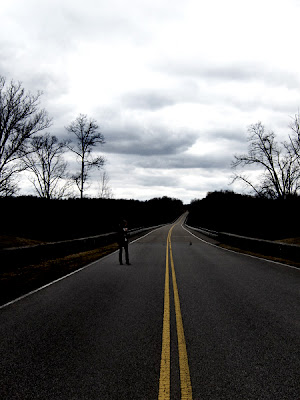
The Natchez Trace was a 440-mile-long path extending from Natchez, Mississippi to Nashville, Tennessee, linking the Cumberland, the Tennessee and Mississippi rivers. It was used extensively by Native Americans and early Caucasian explorers as both a trade and transit route in the late 1700s and early 1800s. Today, the trail has been commemorated with the 444-mile-long Natchez Trace Parkway which follows the trail's approximate path.
The Natchez Trace Parkway Bridge is the nation's first segmentally constructed concrete arch bridge. Spanning 502 m (1,648 feet), the double arch structure offers motorists a view from 47m (155 feet) above the valley floor and is one of the final links in the Natchez Trace Parkway project. The bridge's arches are designed to support the deck without evenly spaced spandrel columns, resulting in a picturesque, unencumbered appearance.
HISTORY LESSON: Many early footpaths were created by the wanderings of bison, deer and other game. In the case of the Trace, bison travelled north to find salt licks in the Nashville area. After Native Americans first began to settle the land, they began to blaze the trail further, until it became a relatively (for the time) well-worn path traversable by horse in single-file.
Many of the first settlements in Mississippi and Tennessee developed along the Natchez Trace. Some of the most prominent of these were Washington, the old capital of Mississippi; "old Greenville", where Andrew Jackson plied his occupation as a slave trader; and Port Gibson, among others.
Despite its brief lifespan, the Trace served an essential function in the years it was in existence. It was the only reliable and most expedient link between the goods of the North and the trading ports of Louisiana. This brought all sorts of people down the Trace: itinerant preachers, highwaymen and traders were just a few. As with much of the unsettled West, the Trace was also a hotbed for banditry. Much of it centered around Natchez Under-The-Hill, as compared with its more tame sister city at Natchez On-The-Hill. Under-the-Hill, where the port to the Mississippi was located, was a hotbed for gamblers, prostitutes and drunkenness. The rowdiest of them all were the Kaintucks, the wild frontiersmen from upriver who came in on the steamboats and flatboats loaded with goods, left them in Natchez in exchange for pockets full of cash, and summarily treated Natchez Under-the-Hill as what could be generously called an early 1800s Las Vegas, Nevada or Amsterdam.
Meriwether Lewis, of the Lewis and Clark Expedition fame, met his mysterious end while traveling on the Trace. Lewis had stopped at Grinder's Stand near current-day Hohenwald, Tennessee for rest. Extremely depressed by the state of his financial affairs (he was deeply in debt), he became drunk as he had many times during the trip. He asked the owner of the stand for gunpowder, which she gave him, intimidated by his behavior. A few hours later, two shots rang out in the night—Lewis had apparently shot himself twice (highly improbable, given the difficulty of [re]loading muzzle-loading firearms, especially after being wounded), once in the head and once in the chest. He lived until the next morning.
...just some interesting facts to go along. I tooke the majority of my photos with film which I will be developing tonight in the darkroom, but I wanted to share some of the pictures I took with my digital as well.


